No. 07 · November 2026 · 400 copies, folded in three
The cup before the café
Specialty coffee likes to tell its story from the farm forward. Ours starts somewhere else: with a pan, a mortar and a pot, and five hundred years of people in this part of the world drinking coffee at night.
Words: the roaster at Mihmas
Printed as a folded sheet for the counter with every new harvest. This is the latest one.
I A drink for staying awake
00:00 — Charge
The first people we can be sure drank coffee were not farmers or merchants but Sufis in Yemen, in the fifteenth century. The chroniclers credit a scholar called Jamal al-Din al-Dhabhani with taking it up around the middle of that century.1 His role is reported by the sixteenth-century writer ‘Abd al-Qadir al-Jaziri. It was a working drink, brewed and drunk through the night so the dhikr could go on until dawn.
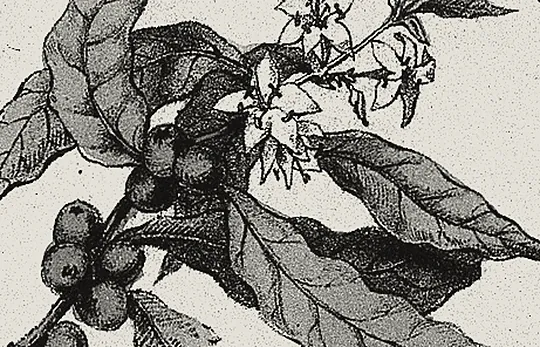
The plant came from across the Red Sea, from the forested highlands of Ethiopia, where coffee still grows wild under the trees. The story of the goatherd whose goats danced after eating the red berries is a lovely one, and a late one: it doesn’t appear in writing until 1671, in a treatise published in Rome.2 The goatherd’s name, Kaldi, seems to be a twentieth-century addition.
II One port
From Yemen the habit travelled with pilgrims and traders. For almost two hundred years, until the end of the seventeenth century, nearly all the coffee traded in the world passed through a single port on the Red Sea coast: al-Mukha. The name stayed with the coffee long after the trade moved on. In English it became mocha, and then a chocolate drink, which is another story.
The word did not start with coffee either. Medieval Arab lexicographers held that qahwa had once been a word for wine; many scholars now think it simply meant something dark. Either way, the name was waiting.
III The house of coffee
Coffee left the lodge and the mosque and went into the street. In 1511 a council in Mecca banned it, worried less about the drink than about the gatherings around it, and the ban did not hold.3 The bans were lifted in 1524. Coffeehouses opened in Cairo and Damascus, and in 1554 two merchants, from Aleppo and Damascus by most accounts, opened one in Istanbul’s Tahtakale district. By then the coffeehouse was what it still is: a room where people who are not family sit together, talk, play, argue about the news and stay longer than they meant to.
IV Pan, mortar, pot
In the desert and in the villages east of the Jordan, coffee took a different shape, and it’s the one we grew up with. Green beans were roasted at the fire in the mihmas, a long-handled iron pan, and stirred until they reached the colour the host wanted. They were cooled on the mibrad, then pounded in the mihbash, a wooden mortar often turned from hard terebinth wood.4 The mihbash is still carved by hand in Jordan. Terebinth has grown scarce, so carvers also use eucalyptus, carob, apricot and fig wood. The rhythm of the pestle carried. Neighbours heard it and knew there would be coffee, and company. The grounds were boiled long in a dallah with cardamom and poured, bitter and sada, a few sips at a time.
None of this is a recipe you can follow exactly. Every house argues about the roast, the cardamom and how many times to boil.
That argument is the tradition.
V Why a roastery is named after a pan
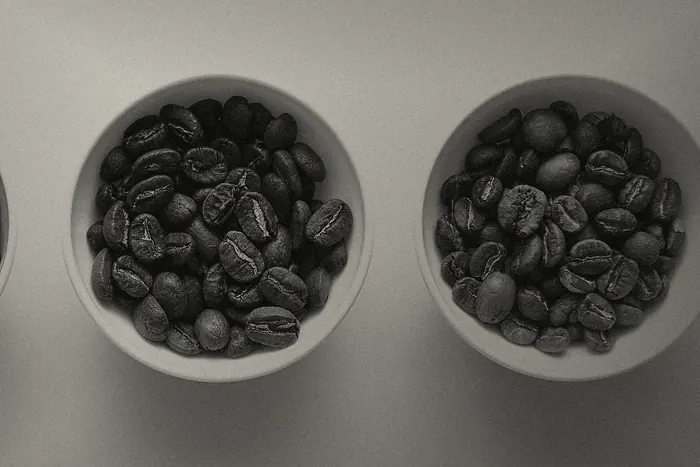
We roast on a drum with a probe and a laptop, and we buy coffee that is graded, scored and traceable to the washing station it came through. That’s the specialty part. But the instinct is the same one that sat by the fire with the mihmas: watch the colour, smell the change, stop when it’s right, and pour for whoever comes through the door.
So Ethiopia and Yemen come first on our shelf, because that’s where all of this began. The bar pours sada every day, from a dallah, the way the street taught us. And on Sunday and Wednesday mornings, if you’re walking along Al-Ba’ouniyah Street, you’ll hear the beans crack.
09:50 — Drop · end of the sheet